Back in 2024, I shared a comparison on LinkedIn that frustrated me: our Android audience was generating 77% higher programmatic ad rates than our iOS audience.
That’s a pretty big gap, especially considering the purchasing power associated with iPhone users.
A big part of the problem is how programmatic advertising recognizes audiences. Safari blocks third-party tracking cookies, limiting the signals advertisers have traditionally used to personalize ads. That can mean lower bids and less revenue for publishers.
Two years later, that gap is still a problem.
So we’ve started doing something about it.
We’re introducing Milla Unified ID, our own first-party reader identity across Narcity and MTL Blog. It gives us a way to build on our direct relationship with readers, with their advertising preferences built into how it works.
This builds on the centralized authentication system we launched earlier this year, which gave readers one login across Narcity, MTL Blog, Milla and Locals.tv. With Milla Unified ID, we’re extending that foundation to include readers who browse without signing in.
We rolled it out about a month ago, and the first thing that changed was coverage. Our ID is now present on 85% of our ad impressions in Google Ad Manager, up from 26% with the identifier we previously used.
That gives us a much stronger foundation to work from. And so far, the revenue signals are encouraging too.
We’re seeing roughly 27% higher eCPMs on Safari iPhone traffic and 13% higher eCPMs on iOS in-app traffic with the new identity. In plain language, that means more revenue per thousand ad impressions. The increases are even higher for logged-in readers.
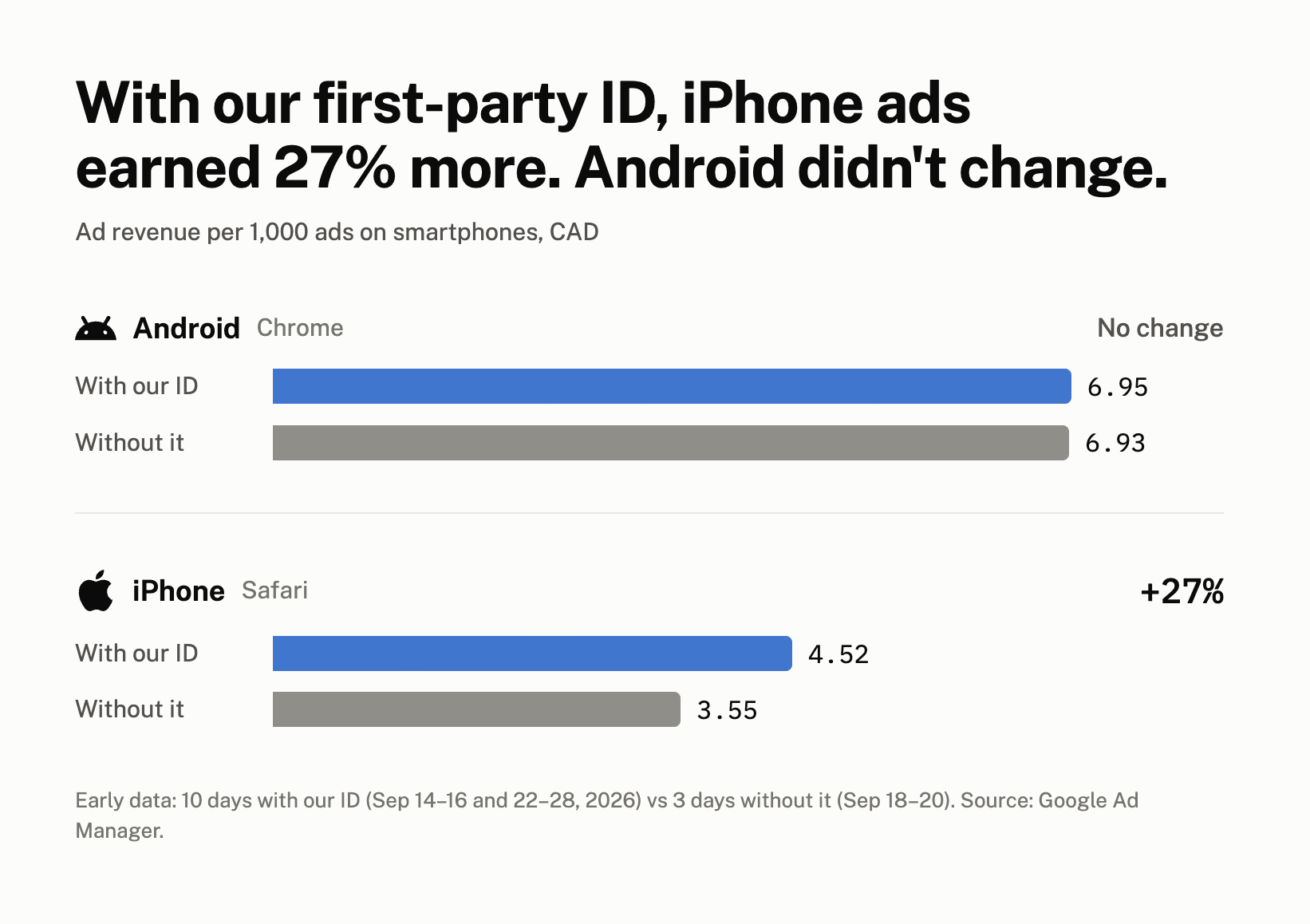
These are early observations. We’re only about a month in, and there’s more work to do to understand how much of the improvement comes from the ID and how those results hold up over time. But it’s a promising start.
The way it works is fairly simple.
Readers receive an identifier that we create on our own domains. More than 2 million readers are already represented. When someone signs in, we can connect their visits across our brands.
Consent comes first. Readers can turn off the advertising use of their identity separately, whether they’re logged in or browsing anonymously. We also respect standard consent signals.
For us, this is a step toward building a stronger business around the audience we already have. Better recognition can help advertisers reach relevant readers and help us earn more from the journalism and content we produce.
We’re still early in building our first-party data stack, but Milla Unified ID is already giving us a foundation to build on.
And honestly, I wish we’d started sooner.