
When someone asks ChatGPT where to eat in Calgary tonight, the answer doesn't come from nowhere. The system reaches into the public web — guides, reviews, journalism — assembles a response, and cites its sources. In that moment, a brand is either part of the answer or it isn't. There is no page two.
This is the new shape of discovery, and it's arriving faster than most marketing plans account for. Research covered by Harvard Business Review finds that roughly half of consumers now use AI platforms to research brands and purchases. After two decades in which "being found" meant ranking on Google, the question facing marketers is shifting: not where do we rank, but are we in the answer — and what is that answer built from?
How we measure brand presence in AI today (AEO)
The honest starting point is that nobody fully knows how these systems choose their sources. The major AI platforms operate differently, disclose little, and change constantly. Anyone selling certainty about "AI optimization" or AEO (answer engine optimization) right now is selling something else.
But the picture isn't blank. Citation data shows how AI systems are actually using publisher content today.
Narcity content has been cited more than 5,000 times across roughly 3,400 articles in Ahrefs' index of AI-generated answers — spanning ChatGPT, Perplexity, Gemini, Copilot, and Google's AI Overviews, the summary boxes that now appear above traditional search results.
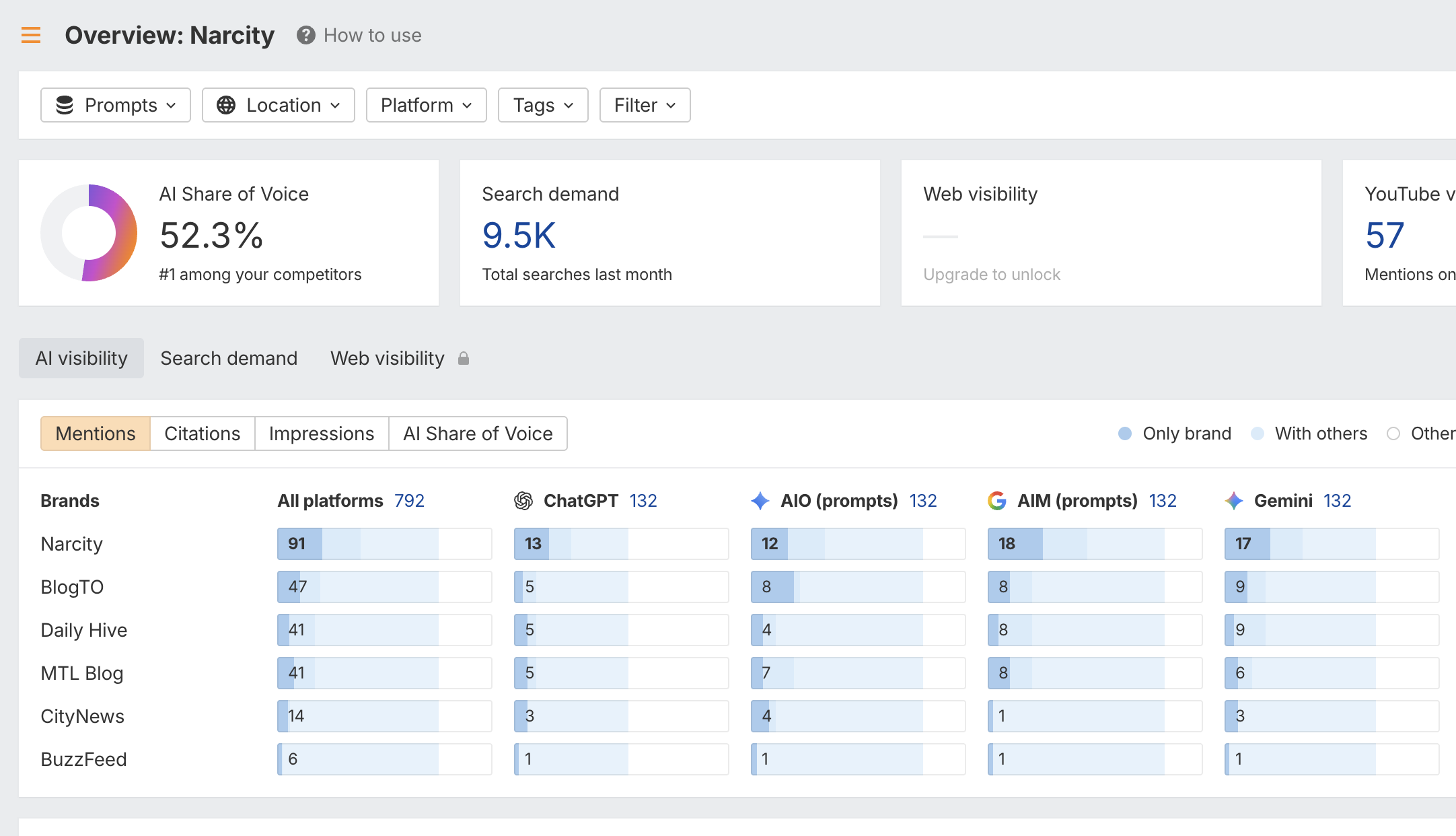
The volume is one thing. What gets cited is the more revealing finding: it's overwhelmingly service journalism. City guides. Roundups. Best-of lists. The articles built to answer a question a real person actually asked. When an AI system needs to explain what to do in Montréal this weekend, it reaches for precisely the kind of useful, structured editorial that publishers like ours have produced for fifteen years.
Where partner content fits in
That pattern carries a lesson for branded content. The most effective branded stories were never the ones that talked loudest about a product — they answered a genuine question. A weekend guide to Montréal. A roundup of Toronto's best patios. A look at how Canadians are rethinking retirement. Useful first, branded second. That approach always made for better publishing. The citation data suggests it's also what AI systems prefer to draw from.
There's a distinctly Canadian dimension to this, too. AI is only as good as the credible information available to it, and for questions about Canadian cities and Canadian life, that pool is thinner than most assume — much of what AI engines cite today comes from forums and social platforms rather than professional journalism. For brands, the implication is stark: a rich, credible digital footprint gives these systems something trustworthy to say about you. A thin one leaves your story to whoever else is talking.
The best investment remains in your brand content
None of this comes with guarantees. No publisher can promise placement in an AI-generated answer, and no responsible one should claim otherwise. What a publisher can do is contribute credible, professionally reported, publicly accessible information about a brand — the raw material AI-assisted discovery runs on — and measure whether it's being picked up.
For years, the question after every campaign was "did people see it?" That question expires when the campaign ends. The one that matters now — "what did this add to our brand's digital presence?" — keeps compounding long after. In a world where the answer box is replacing the results page, that may be the difference between being discovered and being invisible.
If you're interested in learning more about how Narcity Media Group can support your brand building efforts and visibility across search engines and chatbots, we're here to help.