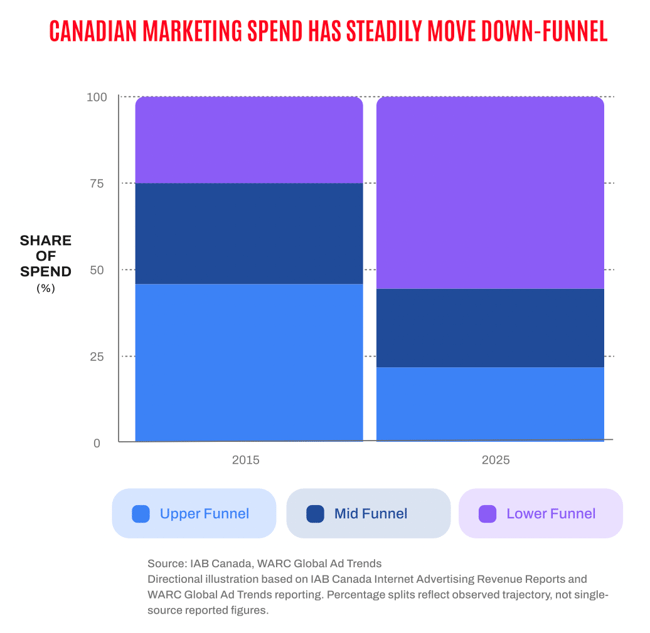
Over the past decade, Canadian marketing became exceptionally good at one thing: efficiency.
Performance marketing delivered clarity. Attribution brought confidence. And every budget discussion seemed to end with the same question: what can we measure right now?
None of that was wrong.
In fact, it was entirely rational.
But, as a result, brands started showing up later in their touchpoints with consumers, and — for most — the relationship became increasingly transactional.
That shift produced gains, but it also had unintended consequences that may have impact beyond the short term.
In other words… as investment moved down the funnel, brand building narrowed and awareness has eroded.
That realization is what led us to create our State of the Industry 2026 paper: Rebuilding Brand Growth Through Culture, Context, and Connection.
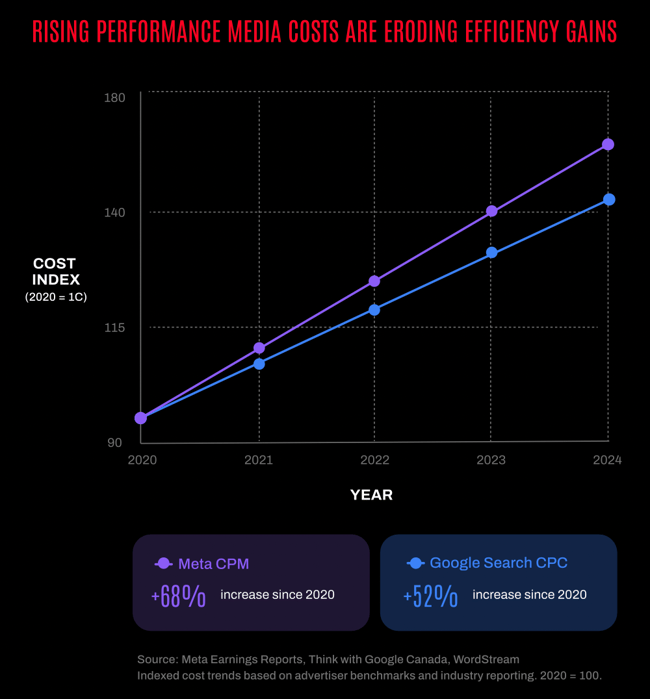
This report is our perspective on where Canadian marketing is heading next, and how brands can rebuild future demand in an environment defined by rising media costs, AI-driven content saturation, and shifting audience trust.
The Case for Rebalancing Brand Growth
If the past decade was defined by performance marketing, the next phase of growth will be defined by something performance alone cannot supply: cultural relevance.
In Canada, relevance often takes shape through key cultural moments. Marketers often default to thinking about moments like the holidays or major sales periods. But the calendar is full of other shared rhythms - from patio season and back-to-school to hockey playoffs, global sporting events, and cultural moments like Pride or TIFF.
These moments carry disproportionate cultural weight in Canada, concentrating attention and creating opportunities for brands to participate in conversations that already matter.
When brands align with these moments credibly, they don’t just advertise, they become part of the story.
Not All Moments Work the Same Way
One of the central ideas explored in the report is that cultural moments are not interchangeable.
In practice, they tend to fall into three categories:
Cultural Identity Moments
Large shared experiences: the Olympics, the Fifa World Cup, Pride, or the start of hockey season — anything that has the ability to build emotional meaning and collective identity.
Seasonal Lifestyle Moments
Moments tied to behavioural shifts in how Canadians live their lives, such as patio and cottage season, summer festivals, back-to-school, and the rhythms of winter.
Transactional Commerce Moments
Peak buying periods like Black Friday/Cyber Monday, and Boxing Day where purchase intent is highest.
Each of these moments plays a different role in brand growth: Cultural and seasonal moments build meaning and relevance over time, while transactional moments convert intent.
When sequenced thoughtfully, they reinforce one another. When treated in isolation, they often create short-term spikes but little lasting impact.
Why This Matters Now
The importance of cultural moments is only increasing.
Several forces are reshaping the marketing landscape simultaneously.
AI is flooding digital channels with content.
More than half of new web articles are now generated primarily by AI, and marketers are producing more content than ever before.
Algorithms dominate distribution.
More than 80% of social content recommendations are now powered by algorithmic feeds.
Trust is shifting.
As misinformation and synthetic media proliferate, Canadians are increasingly skeptical about the sources of the content they consume.
In this environment, volume is no longer the advantage; meaning is.
And meaning tends to emerge in environments that understand the cultural context in which audiences live.
Platforms Reach. Canadian Media Resonates.
Global platforms are powerful tools for distribution. They deliver scale, efficiency, and precise targeting.
But they are not designed to interpret culture.
Canadian media, operates closer to the cultural ground. It understands regional identity, the rhythms of Canadian life, and the difference between a passing trend and a moment that truly matters.
That proximity allows brands to show up in ways that feel aligned rather than inserted. It’s a distinction that can significantly affect how messages are received and remembered.
The Brands That Win Will Be Felt
Ultimately, the next era of brand growth in Canada will belong to brands that understand a simple truth: People don’t remember ads; they remember how brands made them feel in moments that mattered.
The goal of this paper isn’t to argue against performance marketing. Performance remains essential.
But performance alone cannot create future demand.
That happens through presence, participation, and cultural fluency.
Download the Full State of the Industry Report
If you’re interested in exploring these ideas further - including the data, frameworks, and examples behind them - you can read our full report here.