Performance marketing is an easy trap to get stuck in. You put a dollar in, you watch a conversion come out, and the dashboard lights up green. It's measurable and it can drive the numbers the C-Suite is after.
So I understand why so many brands go all-in on bottom-of-funnel marketing. When budgets are tight and everyone wants proof of ROI, the pressure to "show results" can take the wheel. What these "results" don't show is that this hyperfocus on performance marketing is actually damaging brand health.
We've seen this story play out many times: marketers pour their budgets toward hitting short-term targets, and everything seems great at first. Then their market share slips and the performance engine that always worked for them stops working the way it once did.
To be clear, the fix here isn't to abandon performance marketing altogether. But I'd love to see more brands thinking back up the funnel toward awareness efforts that will keep their brand growing many years down the line.
Here are just some of the reasons why a full-funnel strategy is instrumental to the health – and survival – of your brand.
Reference table
Without top-of-funnel marketing, you're missing chances to connect (and convert)
You can't rush a real emotional connection with your customers
Your ROI on bottom-of-funnel spend isn't what you think it is
Local reach beats global reach, and it matters across the whole funnel
The takeaway: Keep your brand on top with a full-funnel strategy
Without top-of-funnel marketing, you're missing chances to connect (and convert)
Brand advertising, storytelling, and useful content do something performance ads can't: they build relationships before anyone is ready to buy. That connection is what keeps you top of mind when the buying moment finally arrives.
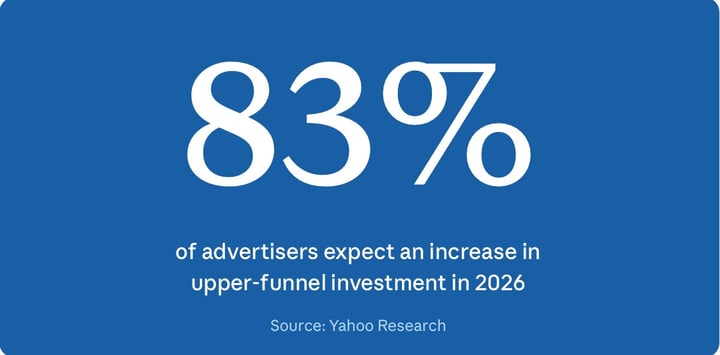
Marketers feel enormous pressure to prove campaign ROI, and that pressure has pushed marketing budgets toward the bottom of the funnel for years. But the pendulum is swinging back. Yahoo Research reports that 83% of advertisers expect an increase in upper-funnel investment in 2026, even as the same advertisers acknowledge mounting pressure to demonstrate campaign ROI.
Why the shift? Because upper-funnel campaigns build the emotional connection that drives consumer loyalty (the kind of loyalty no retargeting ad can manufacture on its own).
Think about your own social media feed. As you scroll through what seems like endless slop, what content actually gets you to pause? Chances are it's not a direct advertisement, but something more emotive that pulls on your heartstrings. It probably has less to do with a specific product or feature and more to do with a story and human experience. This is where upper-funnel campaigns thrive.
You can't rush a real emotional connection with your customers
The structural problem with leaning too heavily on performance marketing is that it harvests demand that already exists. But if you're only thinking about nudging buyers who are already about to convert, you're fumbling your chance to bring new buyers into your world.
To really sustain success, you need to build emotional resonance with your customers in a way that short-term strategies too often forgo. Turns out, you can't cheat connection.
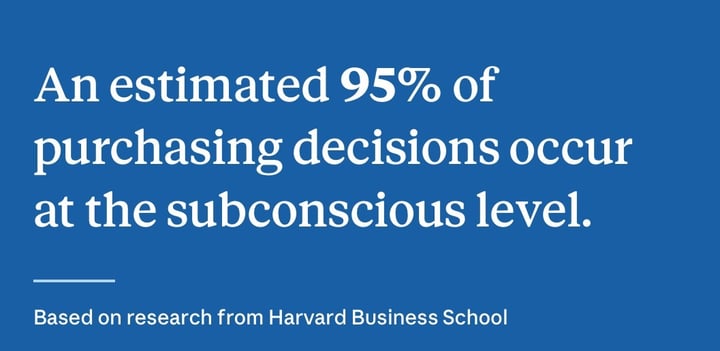
Harvard professor Gerald Zaltman estimates that 95% of purchasing decisions occur at the subconscious level. If you have invested in building an emotional connection with your customers, this decision process will work in your favour. If you haven't, you stand to lose a large portion of potential sales.
The brands that build that connection get paid back for it. Harvard Business Review found that emotionally connected customers are 52% more valuable to brands than customers who are simply satisfied. Forrester Research found that companies that excel at lead nurturing generate 50% more sales-ready leads at 33% lower cost.
If your entire strategy is built around converting your audience at the bottom of the funnel, you're fighting a losing game. You may have a rational argument for why your audience should choose you over competitors, but your audience isn't guided by rationality alone. Without the legwork upfront to connect with your customer segments, your marketing efforts will quickly fade from the hearts and minds of your would-be buyers.
Your ROI on bottom-of-funnel spend isn't what you think it is
Setting strategy aside for a moment, I want to talk about the measurement problem I'm seeing with performance marketing. More often than not, ROI on bottom-of-funnel spend is likely being inflated.
Even sophisticated marketers are prone to setting up campaigns where single conversions are routinely double-counted across platforms. The problem is structural, as different ad networks run disparate tracking and attribution systems that rarely talk to each other. So if a user clicks a Facebook ad, then later clicks a Google ad before buying, both platforms can claim 100% of that conversion. If you're looking at two dashboards and adding up two "wins," you're counting one sale twice.
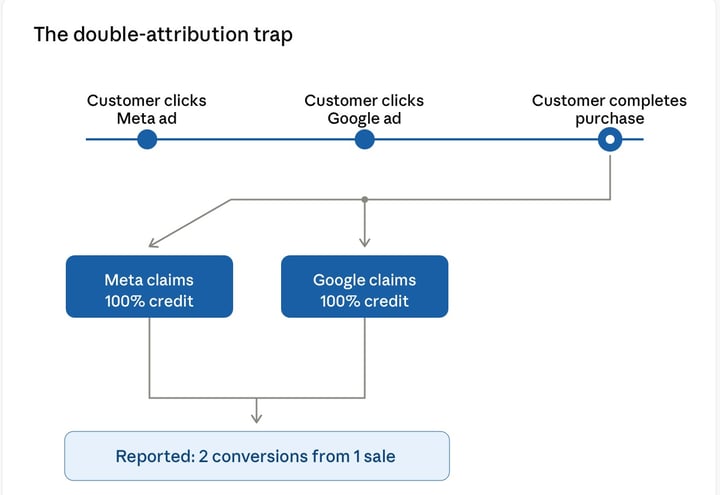
Multiply that across thousands of conversions and your reported ROI may be incredibly inaccurate. This leads you to over-invest in campaigns that look much more efficient on paper than they actually are in practice.
Marketers seem at least somewhat aware of this problem. A 2026 survey found that 5 in 10 US decision-makers only measure "what's easy, expected, or visible."
But what's visible doesn't tell the full story. Lunio's 2026 report demonstrates just how high Invalid Traffic (IVT) rates are across digital channels, with TikTok, X, Meta, and Google among the worst offenders. The same report suggests that globally, IVT led to $63 billion in wasted ad spend in a 12-month period. With IVT adding another layer of distortion to digital campaign metrics, the "success" of bottom-of-funnel campaigns may be even worse than we realize.
Local reach beats global reach, and it matters across the whole funnel
Global digital platforms are increasingly saturated with AI slop and ads in equal measure, and we're witnessing a real erosion of consumer trust on social platforms. A sentiment survey of working-age consumers found that 41% of US consumers do not trust information on social media platforms, with an additional 39% finding it only "somewhat" trustworthy. With a large portion of consumers treating what they see on social media with skepticism at best, your brand needs to work overtime to gain and keep trust within that environment.
Local and domestic media offer a way out of that noise. Local outlets understand the specific needs and interests of their communities, and that community engagement translates into brand affinity. Just as importantly, local media offers a level of credibility and brand safety that global platforms increasingly can't match, thanks to AI, fake news, and a broader disintegration of consumer trust.
Of course, local isn't only a top-of-funnel play. But if your audience encounters your brand in an environment they actually trust, chances are they'll have a stronger connection by the time they're ready to buy.
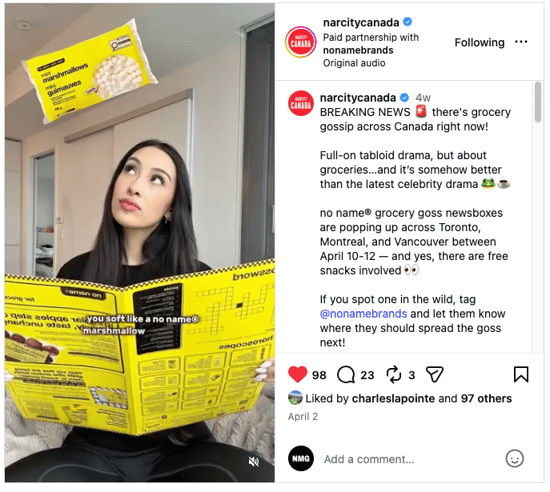
A recent campaign from no name® demonstrates how building local brand awareness can have a major impact. When no name® launched "grocery goss" newsboxes across Toronto, Montreal, and Vancouver, they gave consumers a memorable way to interact with their brand in local neighbourhoods. The activation offered a 2000s-style tabloid magazine and free snacks; it also bridged to digital experiences by providing a URL where consumers could submit their own "grocery goss" online.
no name® partnered with Narcity to reach Gen Z and young Millennial Canadians across these three cities, demonstrating how advertising with domestic platforms – that already have a relationship with your target demographic – can be a force multiplier in creating an emotional connection with your brand.
The takeaway: Keep your brand on top with a full-funnel strategy
None of this is an argument against performance marketing. Capturing in-market demand is essential – the mistake is believing that's the whole strategy.
Brands need a full-funnel strategy across platforms that:
- Captures existing demand at the bottom of the funnel with performance marketing.
- Builds new demand at the top with brand advertising, storytelling, and useful content.
- Roots itself in domestic and local media channels that have earned their audiences' trust.
Keep your performance engine running, but don't ask it to do the work that only brand-building can.
It's easier than you think to drive attention and influence audiences across local and national platforms. Get in touch with us at Narcity Media to learn more.